Criterion
-
Hardness
-
Movement & hairline cracks
-
Chemical & oil load
-
Underfoot comfort & noise
-
Typical spaces
-
Density
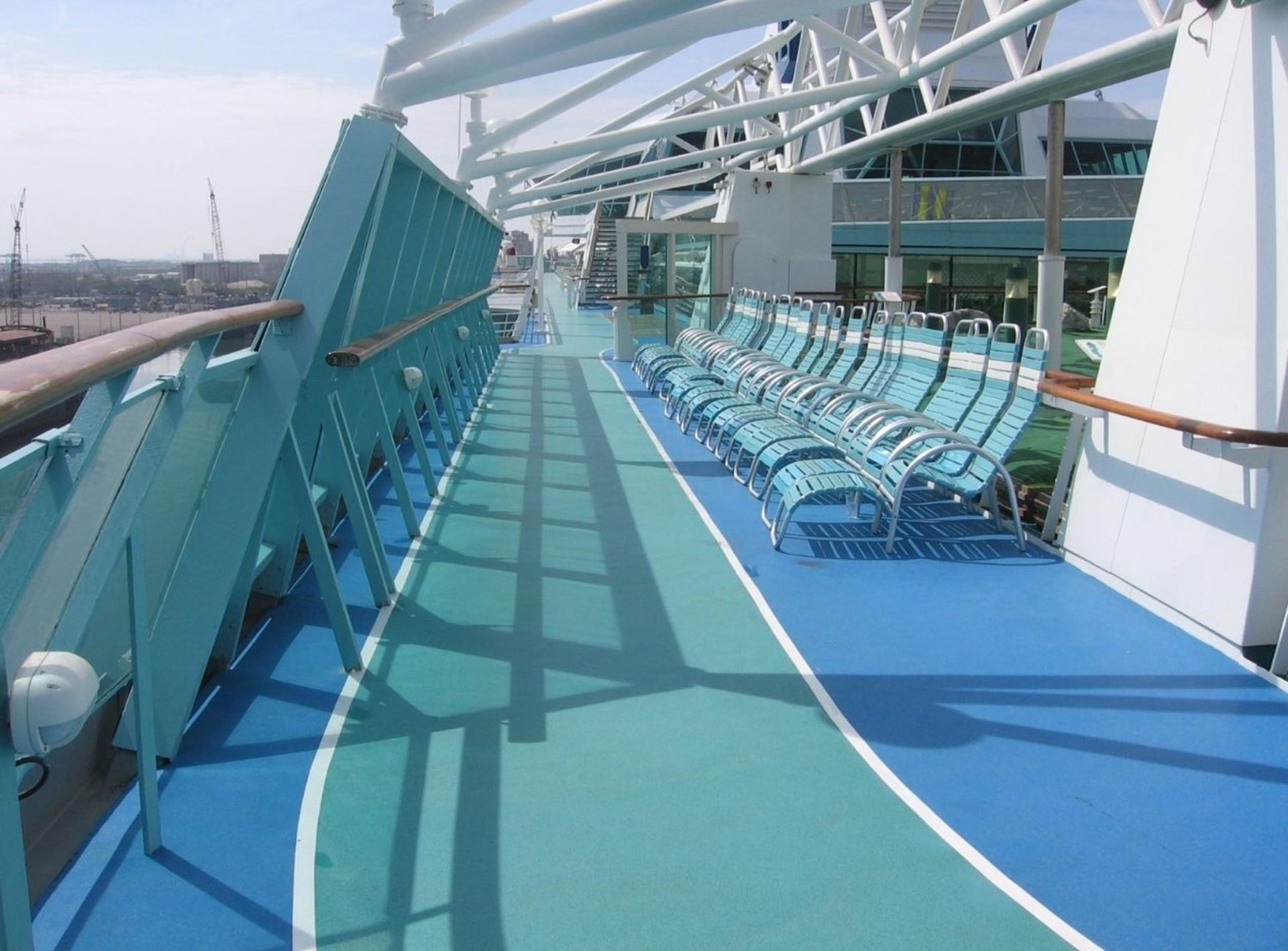
A marine resin floor is applied as a liquid and cures in place, so it arrives as one continuous surface — no seams to weld, no joints to lift. That is why resin, not sheet material, is what goes down in engine rooms, workshops, galleys, wet rooms and on exposed decks.
The whole decision is then one question: epoxy or polyurethane. Epoxy for hardness and chemical attack, polyurethane for movement and comfort. Trivaro supplies the GTF Freese marine programme — coatings, quartz build-ups, comfort floors and synthetic teak — across Europe with IMO documentation.

Sheet coverings need welded seams and detailing at every upstand. A resin deck has none of that — which changes six things at once.
The surface cures as one piece. There is no welded joint to open under thermal movement, washdown or a dropped tool.
Perimeters, plinths and drain surrounds are formed in the same resin, so the waterproof line is continuous into the vertical.
Machinery spaces see fuel, lube oil, hydraulic fluid and cleaning agents. Epoxy chemistry is specified against that exposure, not against footfall.
A quartz broadcast sets the texture deliberately — the same system can finish smooth-cleanable or heavily anti-skid depending on the space.
Frames, hatch surrounds, foundations and odd geometry are coated as found — no templating, no offcuts, no fitting loss.
Damage is ground out and recoated locally. There is no need to lift a sheet or open a seam across the compartment.
Rule of thumb: epoxy where the floor is attacked, polyurethane where the floor moves, comfort polyurethane where people stand on it all watch. Most vessels specify two of the three.
Hardness
Movement & hairline cracks
Chemical & oil load
Underfoot comfort & noise
Typical spaces
Density
Hard — around Shore D 80
Rigid — needs a sound, stable substrate
Highest resistance of the three
Hard and acoustically bright
Engine rooms, workshops, stores
Around 1530 kg/m³
Elastic — around Shore D 45
Bridges deck movement and hairline cracks
Good, below epoxy on aggressive chemicals
Warmer and quieter than epoxy
Circulation, decks that flex, exteriors
Around 900 kg/m³ — lighter
Softest of the three — resilient layer
Most tolerant of substrate movement
Adequate for accommodation duty
Best — standing comfort and footfall noise
Mess rooms, control rooms, accommodation
Lightest build-up of the three
Four product families from the GTF Freese marine programme, each with a different job on the deck. Tell us the space and its exposure — we return the build-up.
Four layers, in sequence. The certificate covers the sequence — changing a layer changes the approval.
Steel is prepared and primed, or a mineral screed is laid first to level the deck. The primer is chosen for the substrate and its moisture condition — this layer decides adhesion for the life of the floor.
The body of the floor: epoxy where chemical and mechanical load rules, polyurethane where the deck moves or comfort matters. Thickness follows the certified system, not preference.
A quartz or filler broadcast sets the slip profile — from smooth and easily cleaned to heavily anti-skid for wet and exterior work.
A sealer or top coat locks in the texture and sets the final cleanability and wear surface, closing the system named on the certificate.
What sits under, beside and above a resin deck.
The layer-by-layer build-up, epoxy versus polyurethane, and the cure schedule in cold docks.
The levelling layer many resin decks are applied over, across a wide density band.
Which rules apply on rigs, platforms and offshore wind vessels — and the zones resin serves.
The full programme — screeds, A-60 insulating systems, primers and deck coverings.
What yards, owners and superintendents ask before specifying a resin deck.
A liquid-applied deck covering built up in layers on the steel or screeded deck — primer, resin coating, a quartz broadcast for texture, then a sealer. Because it cures in place it forms a jointless surface with no seams to weld or fail, which is why resin dominates machinery spaces, galleys, workshops and wet rooms. The resin is either epoxy (hardness, chemical resistance) or polyurethane (elasticity, comfort).
Epoxy is harder and more chemically resistant — around Shore D 80 — for mechanical load, oils and cleaning agents: engine rooms, workshops, stores. Polyurethane stays elastic at around Shore D 45, so it bridges deck movement and hairline cracks and feels warmer and quieter underfoot — for accommodation circulation, mess rooms and decks that flex. It is also the lighter build-up. Most vessels use both, zone by zone.
The GTF Freese systems we supply are tested to the IMO FTP Code 2010, Parts 2 and 5 — surface flammability, and smoke and toxicity for deck coverings. Approval belongs to the system as applied, so the certificate names the build-up: primer, coating, filler and sealer in a defined sequence and thickness. Substituting a layer voids the approval. We supply the certificate and datasheets with every order.
Usually yes, if the substrate is sound, dry and correctly prepared. Systems are applied over prepared steel or over a mineral levelling screed, with the primer matched to the substrate. Cure is temperature-driven, so the work window follows deck and air temperature rather than the calendar — the deciding factor in an unheated dock. Each datasheet states its substrate limits and minimum temperatures.
Yes — TEFROteak is a liquid-applied synthetic teak system: the appearance and grip of a teak deck without laid timber, caulking or the sanding cycle. It suits walkways, external stairs, exposed decks and boat landings where salt, UV and pressure washing rule out natural timber upkeep.
We are a materials supplier — most resin decks reach us as a materials package for the yard’s or owner’s own applicator, quoted per system and zone and delivered across Europe from our Estonian warehouse. Where a project wants it, installation by certified teams can be arranged separately.
Trivaro supplies marine resin deck systems across Europe — epoxy and polyurethane deck coverings, quartz-broadcast build-ups, comfort floors, synthetic teak and the primers beneath them — with IMO documentation for your classification file.
Send the spaces, their areas and what the floor is exposed to. We respond with a certified build-up per space, datasheets and a B2B quotation.
GTF Freese
TEFROKA EP N
GTF Freese
TEFROKA EP-R
GTF Freese
TEFROKA HLS Deck Covering
GTF Freese
TEFROKA HLS Sealer
GTF Freese
TEFROKA PU-1-L
GTF Freese
TEFROfloor EP
GTF Freese
TEFROfloor EP COATING
GTF Freese
TEFROfloor EP COATING L
GTF Freese
TEFROfloor EP-W
GTF Freese
TEFROfloor PU COATING
GTF Freese
TEFROfloor PU COMFORT H
GTF Freese
TEFROfloor PU-E
GTF Freese
TEFROteak
GTF Freese
TEFROtop PU W